 By MyJobAlly
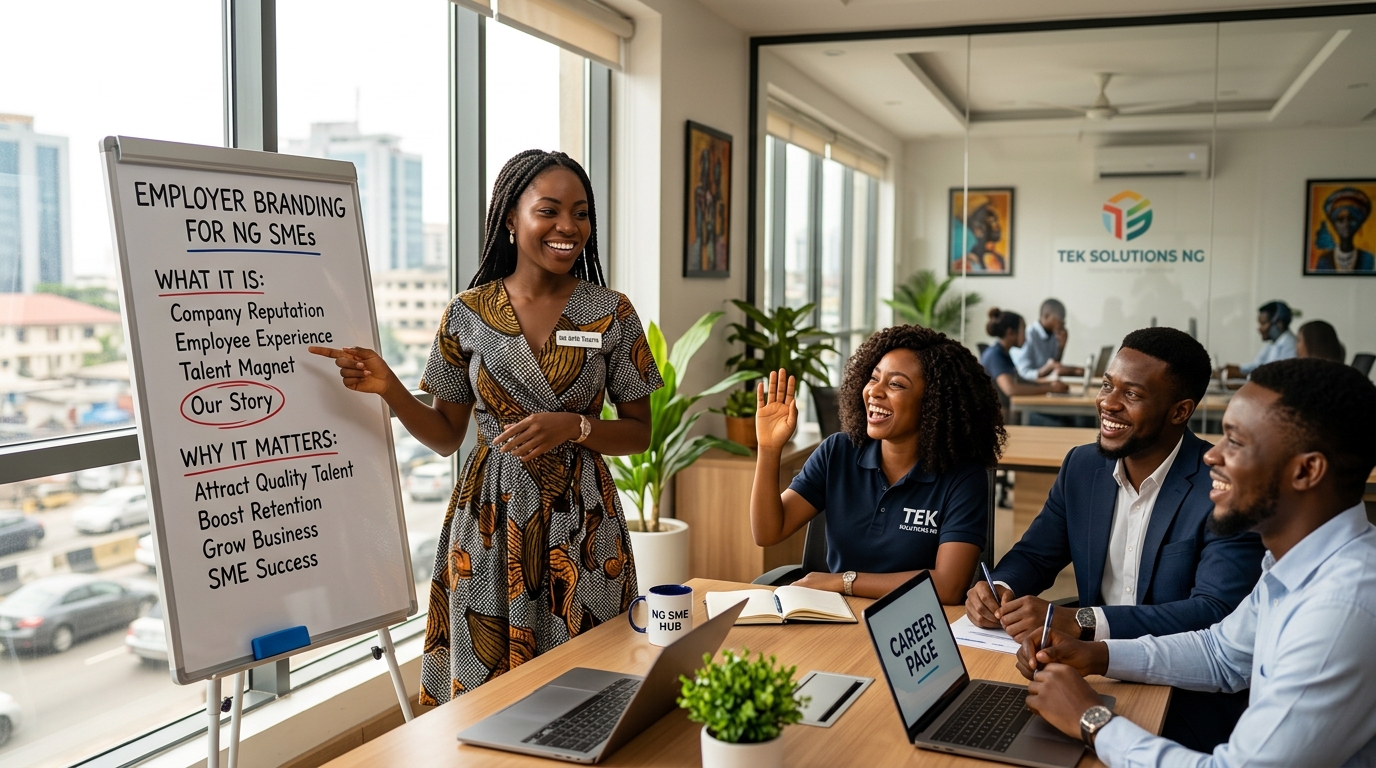
Small businesses can't outspend the multinationals on salary. They can still win on reputation.
Ask a Nigerian SME owner what "employer branding" means and you'll often get a slightly wary look, the kind reserved for corporate jargon that sounds expensive and irrelevant to a fourteen-person company still figuring out payroll software. It sounds like something Google or a multinational bank invests millions in: a slick careers page, a viral recruitment video, a stand at a graduate fair with branded tote bags. And if that were actually what employer branding required, the wariness would be fair. Most Nigerian SMEs genuinely cannot compete with that kind of budget, and shouldn't try.
But that's not what employer branding actually is, and treating it as a large-company luxury is exactly the mistake that leaves so many good small businesses losing talent to competitors who simply aren't better employers, just better known ones. Employer branding, stripped of the marketing language, is simply the answer to a question every candidate is already asking themselves before they apply anywhere: what is it actually like to work here? Every company has an answer to that question, whether it has deliberately shaped one or not. The only real choice a business gets is whether that answer is left to chance, built out of scattered impressions, old rumours, and a single bad Glassdoor-style review, or whether it's something the business has actually thought about and communicated on purpose.
The Specific Problem Nigerian SMEs Are Fighting
This isn't an abstract concern. It sits on top of a genuinely difficult structural reality. SMEs make up roughly 96 percent of all businesses in Nigeria and account for around 84 percent of total employment, which means the vast majority of Nigerian workers are, at some point, going to work for a company that looks a lot more like a fifteen-person firm than a multinational headquarters. And yet these same businesses are competing for talent against multinationals, large local conglomerates, and the public sector, all of whom can offer salary structures a small business simply cannot match.
Layered on top of that is Nigeria's well-documented brain drain problem. Estimates suggest that more than a fifth of Nigerian graduates emigrate within five years of completing their education, chasing opportunities abroad that pay in stronger currencies. What this leaves behind, according to research on West African SME hiring, is smaller businesses fighting each other, and the multinationals, over a shrinking pool of strong local candidates, frequently losing that fight on salary alone and ending up with a workforce that then requires more supervision and support than the business is resourced to provide. The pattern compounds itself: a business that can't attract strong candidates ends up with weaker hires, which increases management strain, which makes the business a harder, less attractive place to work, which makes the next hiring round even tougher.
Employer branding is not a solution to brain drain, and no SME should expect it to reverse a national economic trend on its own. But it is one of the few genuinely available levers an SME actually has in this fight, because unlike salary, it doesn't require deep pockets. It requires honesty, consistency, and a willingness to actually say out loud what makes working at the business worthwhile, if anything currently does.
What Employer Branding Actually Consists Of
At its core, employer branding is the lived reality of working somewhere, and how clearly and honestly that reality gets communicated to the people who might join. It includes how leadership actually behaves day to day, not just what's written in a mission statement. It includes how decisions get made and communicated, how growth and learning actually happen (or don't), what the workplace culture genuinely feels like from the inside, and how current employees talk about the business when nobody official is listening.
This matters because candidates increasingly evaluate potential employers the way they'd evaluate anything else they're about to commit to: they ask around, they check what current or former employees say, they read whatever reviews or informal reputation exists, and they weigh all of it against the salary and title on offer. A business with a below-market salary but a genuinely strong reputation for how it treats people can and often does out-compete a higher-paying employer with a poor one, because compensation is only ever part of the calculation candidates are actually making.
Why This Advantage Is Bigger for SMEs Than Most Owners Realize
Here is the part that should genuinely change how a Nigerian SME owner thinks about this topic, rather than dismissing it as a big-company concern. Research specifically comparing employer branding in small and medium enterprises against large corporations has found something counterintuitive: SMEs actually have a structural advantage in building a strong employer brand, not a disadvantage, precisely because of their size.
In a large company, employer brand is a somewhat abstract thing, managed by an HR department and a marketing team, filtered through layers of corporate messaging before it ever reaches an employee. In a small business, it's the opposite. Employees have direct, regular access to the founder or owner. Leadership behaviour isn't filtered through management layers, it's visible, immediate, and personal. That closeness builds a kind of trust and psychological safety that's genuinely hard for a large, bureaucratic organisation to replicate, precisely because a large organisation has too many layers between a new hire and the people actually setting the tone.
In practice, this means an SME owner who is genuinely fair, communicates honestly, and follows through on what they say isn't just being a decent boss, they're building the single strongest employer brand asset available to a small business: a direct, credible reputation that current and former employees will vouch for personally, in exactly the informal conversations candidates now rely on before deciding where to apply.
What Strong Employer Branding Actually Buys a Business
The return on this isn't abstract goodwill. Across recent research and industry reporting on hiring trends, a consistent, practical set of outcomes shows up wherever employer branding is genuinely strong:
Better-qualified candidates apply in the first place. A business known for treating people well attracts a stronger applicant pool without necessarily paying more for advertising or recruitment, simply because word travels and people actively seek the business out.
Time-to-fill drops. Roles at businesses with a strong, clear reputation tend to get filled faster, because candidates arrive already interested rather than needing to be persuaded from a cold start.
Retention improves. Candidates who join with an accurate picture of what the job and culture are actually like are less likely to leave early out of surprise or mismatch, one of the more expensive and disruptive patterns a small business can experience.
It offsets, at least partially, the salary gap. This is the point most directly relevant to an SME's actual constraints. Candidates weighing an offer against a higher-paying competitor will sometimes choose the lower salary specifically because the reputation, culture, and growth path feel more genuine and better understood, particularly when transparency about pay and progression removes the ambiguity that makes candidates default to the safer-seeming, higher-paying option.
What This Actually Looks Like for a Small Nigerian Business
None of the following requires a marketing budget, a dedicated HR team, or professional video production.
Be honest about what the job and the company actually are, in the job advert itself. Vague, inflated job postings that oversell the role create mismatched hires who leave within months once reality sets in. A clear, specific, honest description filters for candidates who genuinely want what's actually on offer.
Let current employees speak, informally, about what it's really like. A short conversation between a prospective hire and an existing team member, even an unscripted five-minute chat, tends to carry more credibility than any polished company description, precisely because candidates are increasingly skeptical of language that sounds too polished to be true.
Be transparent about growth, even when the path is modest. An SME doesn't need an elaborate corporate ladder to offer this. It needs to be honest about what skills someone will build, what responsibilities might grow into over a year or two, and what a genuine next step could realistically look like, rather than a vague promise of "growth" with nothing concrete behind it.
Treat the first ninety days as part of the brand, not just onboarding paperwork. How a new hire is welcomed, trained, and supported in their earliest weeks shapes what they'll say about the company to friends and former classmates for years afterward, in exactly the informal networks that feed a small business's next round of applicants.
Show up consistently as an employer online, even minimally. A LinkedIn page that occasionally shares real moments, a new hire, a small win, a genuine reflection from the founder, does more for reputation over time than a single, expensively produced recruitment campaign that runs once and disappears.
Fix internal problems before trying to market around them. Employer branding cannot paper over a genuinely poor working environment for long. Employees talk, reviews circulate, and word travels fast in a market where trust between candidate and small employer is precisely the asset being built. The most durable employer brand strategy any SME has access to is simply becoming, honestly, a better place to work, and then being willing to say so clearly.
Bringing It Together
Nigerian SMEs are never going to out-salary a multinational bank or a well-funded tech unicorn, and pretending otherwise wastes energy better spent elsewhere. What they can do, and what research on small business employer branding consistently points to as a genuine structural advantage rather than a consolation prize, is build the kind of direct, personal, trustworthy reputation that large, layered organisations often struggle to replicate at all. That reputation doesn't require a budget. It requires an owner willing to be honest about what the business actually offers, consistent in how people are treated, and deliberate about letting that reality be heard by the people deciding where to apply next. In a hiring market as competitive and talent-scarce as Nigeria's currently is, that may be the single most cost-effective advantage a small business has left to build.
This article draws on current employer branding research and industry reporting, including comparative studies on employer branding in small and medium enterprises, alongside Nigeria-specific labour market and SME statistics current as of mid-2026.