 By MyJobAlly
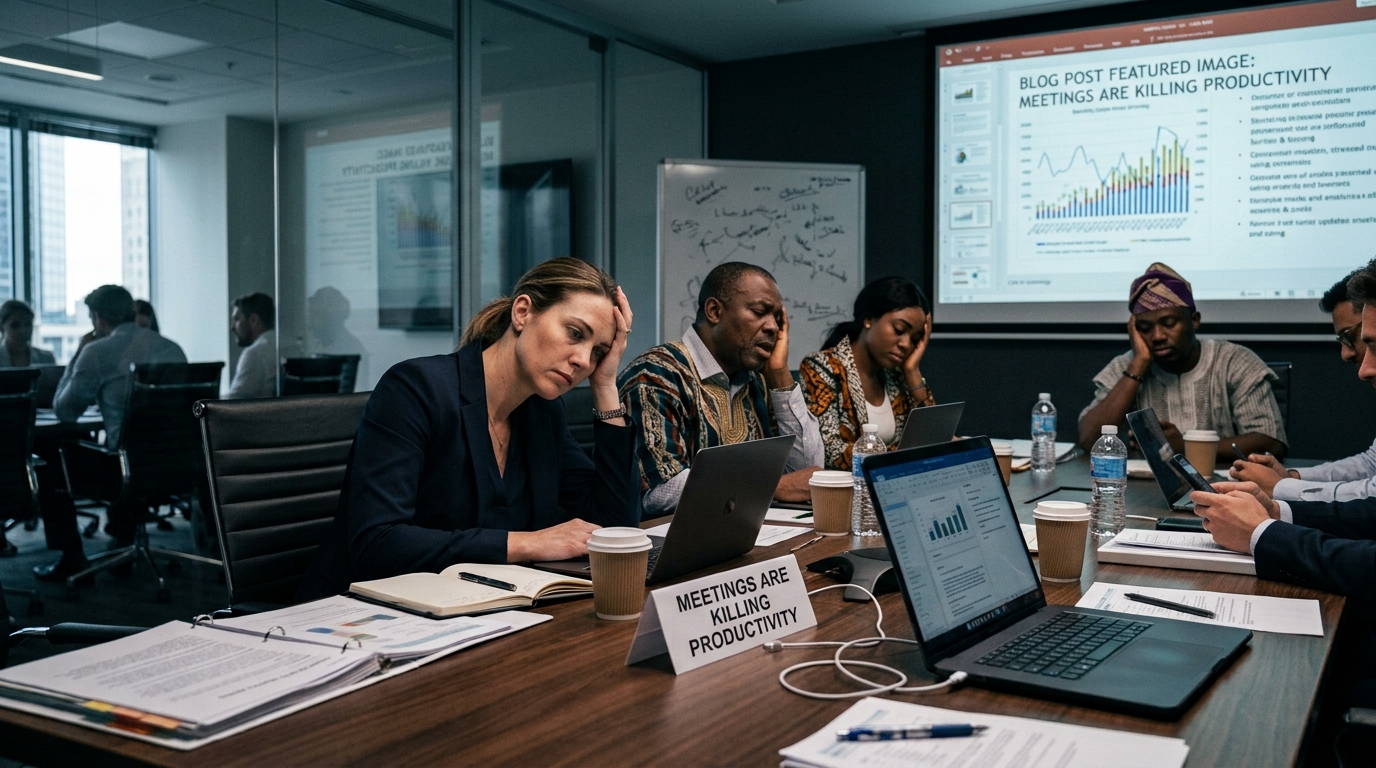
Your calendar may be the biggest hidden cost in your business. Here is what the research says about how meetings drain focus, why bad ones persist, and which fixes hold up under scrutiny.
That matters for employers more than for anyone else, because meetings are a cost you control. You can't easily change inflation, electricity supply, or the labour market. You can change what is on your team's calendar on Monday morning.
This article ranks what the evidence supports, flags where it is weaker than the headlines suggest, and shows what the numbers could mean for a Nigerian business. Most of the large studies below come from the United States and global technology companies, so treat them as benchmarks rather than Nigerian forecasts.
First, Count What Meetings Really Cost
Start with time. A 2026 benchmark report from Laxis, compiled from several vendor and platform sources, puts average meeting time at 11.3 hours a week, about 28 percent of the working week, and says 35 percent of business meetings are considered a waste of time (Laxis). Microsoft's telemetry from its 365 platform paints a heavier picture: roughly 15.4 hours a week in meetings against 12.1 hours of uninterrupted focus work, as summarised in the same report. These are different samples, so don't expect the figures to match. Both say the same thing: meetings now compete with focused work for the biggest share of the week.
People themselves agree. In a survey of more than 600 white-collar US employees, about 30 percent of meetings were judged unnecessary, workers reported losing nearly six hours a week to them, and over 80 percent said their productivity would improve if they could skip them (Scripps News, reporting the survey and comments by meetings researcher Steven Rogelberg). A vendor survey by ClickUp similarly found that nearly 30 percent of meetings could be replaced with asynchronous work (ClickUp). Remember that vendors selling collaboration software have a commercial interest in these findings.
A worked example for a Nigerian employer. A 2026 compensation survey of more than 800 employers in Lagos, Abuja, and Port Harcourt put the average monthly salary at ₦375,000 (MyJobMag guide citing the MaxisHR survey, as summarised by HiveDesk). The sample leans toward larger formal employers, so it overstates what many businesses pay. Still, use it as an illustration. Divided across roughly 173 working hours a month, that is about ₦2,165 an hour in salary alone. A one-hour weekly meeting for 10 such staff costs about ₦21,650 a week, or roughly ₦1.1 million a year, before you count the cost of lost focus afterwards. If even a third of such meetings add nothing, that is a recurring expense with no return. The exact figure will differ in your business. The point is to price the meeting the way you would price any other recurring cost.
The Real Damage Is Fragmentation, Not Hours
The hours are only half the problem. The bigger issue is what meetings do to the time around them.
Microsoft's 2025 Work Trend Index, which drew on telemetry from its 365 platform and a survey of more than 30,000 knowledge workers, found that employees are interrupted roughly every two minutes during core hours, which works out to about 275 interruptions a day from meetings, emails, and notifications (HR Executive). Half of all meetings land in the two windows when most people concentrate best, 9 to 11 in the morning and 1 to 3 in the afternoon, and 57 percent of meetings are ad hoc with no prior invitation (Workplace Insight).
Why does that hurt? Research by Gloria Mark at the University of California, Irvine found that people switch between working spheres about every 10 and a half minutes, and that returning to an interrupted task takes on average over 23 minutes (Gallup interview with Gloria Mark). Treat the exact seconds with care, since the figure is an average from a specific study of mixed interruptions, not a law of nature for every meeting. But the order of magnitude is sound: recovery takes tens of minutes. One analysis points out that when meetings arrive every couple of hours, the gaps left over are often shorter than the time needed to settle into deep work (ThisAndThat summary of the research).
In practice, a 30-minute meeting at 10:30 doesn't cost 30 minutes. It can wreck the whole morning.
Why Bad Meetings Persist
If meetings are this costly, why do they multiply? The research offers three reasons.
Leaders misjudge their own meetings. Rogelberg has reported that leaders are poor judges of how well they run meetings, which makes them reluctant to cut back (SHRM). Part of the appeal is simple: calling a meeting makes a manager feel productive.
Employees feel guilty about skipping. The same coverage notes that staff often feel they must attend, and the resulting stress is counterproductive.
Nobody prepares. Microsoft found that PowerPoint edits spike 122 percent in the ten minutes before a meeting begins, a sign that preparation is often squeezed to almost nothing (HR Executive). Vendor survey data adds that many recurring meetings have no clear agenda, though figures vary widely by source.
UK research by Brother found that over half of office workers (55 percent) felt they wasted too much time in meetings, blaming waffling, small talk, late joiners, and inattention (Print in the Channel, reporting Brother UK). None of those are structural problems. They are habits, and habits can be changed.
What Nigerian Employers Should Add to the Picture
Nigeria-specific meeting data is scarce, so be careful before assuming US numbers apply. Two local factors do change the maths. First, the Nigerian Workplace Report found that remote and hybrid workers named electricity and internet as their top challenges, ahead of motivation or time management (Intelpoint). A video call that drops, or a power cut halfway through, wastes the attendance cost of every person in it. Second, commute time in cities such as Lagos means an in-person meeting can cost far more than its scheduled hour. Both are reasons to ask harder questions before calling any meeting, not reasons to avoid meetings altogether.
If your team works partly online, see our guide on how Nigerians are making a living working online for how remote work is shaping expectations.
Fix 1: Audit Before You Cut
Begin with data, not instinct. Rogelberg suggested asking employees to record the number of meetings they attend and the time they spend in them over a week (SHRM). Export one week of calendars, then sort the meetings by recurring status, attendee count, and purpose.
Speed: one to two weeks. Size: unlocks every other fix. Risk: low, as long as staff know it is not a surveillance exercise.
Fix 2: Protect Meeting-Free Time
The best-known study here is a 2022 MIT Sloan Management Review survey of 76 companies, each with more than 1,000 employees, that had introduced between one and five no-meeting days per week. Employees reported higher autonomy, cooperation, and satisfaction, and lower stress and micromanagement. The authors found the best results at companies with three meeting-free days, and that dropping meetings entirely had negative effects (MIT Sloan Management Review; published version via the University of Reading).
Two cautions matter. The study relied on employee ratings, not measured output, so a 71 percent productivity gain means perceived productivity rose, not that revenue did. And critics note that no-meeting days can push the load onto the remaining days if nothing else changes. Start with one protected half-day or one meeting-free day, then measure.
Speed: immediate. Size: moderate to large, depending on your starting point. Risk: low if client-facing teams get exceptions.
Fix 3: Make Every Meeting Earn Its Slot
A meeting should exist because it needs real-time discussion, a decision, or trust-building. Status updates usually fail that test. Before sending an invitation, require three answers: what is the purpose, what decision or output do we want, and who must be there? Cut the invite list to those who contribute or decide. Rogelberg has said it is fine to give staff permission to skip non-critical meetings, provided a mechanism keeps them informed (Scripps News). A short written summary after each meeting does that job.
Speed: a few weeks. Size: large, because it cuts both the number and the length of meetings. Risk: low.
Fix 4: Default to Written Updates
Move routine status updates into a shared document or message thread, and keep live time for problem-solving. This only works if people actually read and respond, so set a clear expectation, such as replies within one working day. Newer AI note-taking and summary tools can help, but they don't fix a meeting that shouldn't exist. If your team is adopting them, our piece on AI skills employers now expect from every candidate shows what good use looks like.
Speed: one to two months to build the habit. Size: moderate. Risk: moderate, mainly unclear written communication.
Fix 5: Shorten, Space, and Time Them Sensibly
Microsoft's data shows peak focus hours are the most crowded. Move recurring meetings toward late morning, lunchtime overlap, or late afternoon, and leave buffers between back-to-back sessions. The Laxis report adds that the leading correctable cause of meeting fatigue is back-to-back scheduling with no buffer, though it is a compiled vendor report (Laxis). Rogelberg also suggested calendar tools offer shorter default windows, since many are fixed at 30 or 60 minutes (SHRM). Try 25 and 50 minutes.
Speed: immediate. Size: small to moderate. Risk: very low.
Be Fair: Meetings Are Not the Enemy
The strongest critics of bad meetings are not against meetings. Rogelberg has argued that abolishing meetings is a false solution and that they can be improved through research-based practice (The Science of Better Meetings). Good meetings build trust, resolve conflict quickly, and help new hires learn how a team works. The MIT Sloan authors also found that eliminating meetings altogether made outcomes worse, not better (MIT Sloan Management Review).
The goal is fewer, better, and better-timed meetings, especially for early-career staff who learn by being in the room. This matters for retention too. Younger workers say they want growth and support, as we found in Gen Z in the workplace: expectations and surprises, and a calendar with no space to learn on the job works against that. Gallup's 2026 global report also found that manager engagement has fallen nine points since 2022, which suggests the people running most meetings are themselves stretched (Gallup).
A Realistic Sequence
- Audit one week of calendars. Count meetings, hours, and attendees, then flag every recurring meeting.
- Cancel or shrink the obvious waste. Start with recurring status meetings and any meeting with no agenda.
- Protect focus time. Pilot one meeting-free day or half-day, and keep client-facing exceptions clear.
- Set simple rules. Require a purpose, a written agenda, a named decision-maker, and a short written summary afterwards.
- Shift routine updates to writing, with a clear reply expectation.
- Measure after four to six weeks. Check meeting hours, team feedback, and delivery against deadlines. Adjust.
- Reward managers who run lean calendars. If promotion and praise go to the busiest managers, the habit will survive any policy.
Hiring and pay also shape how people experience workload. If you are competing for talent, see salary transparency laws and what employers need to know and our guide to equity compensation for small business employers.
What Not to Do
Don't ban meetings overnight. The evidence suggests removing every meeting backfires. Don't confuse a full calendar with a productive team. Busy is not the same as effective. Don't replace meetings with endless messages. A flood of chat notifications interrupts focus just as much, and Microsoft's data counts messages and emails among the interruptions. Don't exempt yourself. Leaders usually call the most meetings, so the example starts at the top. Don't lead with surveillance. Use calendar data to fix the system, not to police individuals.
The Bottom Line
Meetings aren't killing productivity by existing. They are doing it through volume, poor timing, and the constant interruption that follows each one. The research supports a handful of practical fixes: price your meetings, protect focus time, require a purpose, move routine updates to writing, and space the rest sensibly. None of it needs new software or a bigger budget. It needs a manager willing to open the calendar and ask which of those hours actually earn their place.
This article draws on Microsoft's Work Trend Index (via trade summaries), Gallup, MIT Sloan Management Review, research by Gloria Mark and Steven Rogelberg, and vendor surveys from Laxis, ClickUp, and Brother UK, alongside a 2026 Nigerian employer compensation survey, current as of October 2026. Most data comes from the United States or global technology samples and is used as a benchmark only. Several figures come from secondary summaries or vendor surveys and are labelled as such. The naira cost example is an illustration based on assumed salaries and working hours, not a measured result. This article is general information, not legal, financial, or HR advice.