 By MyJobAlly
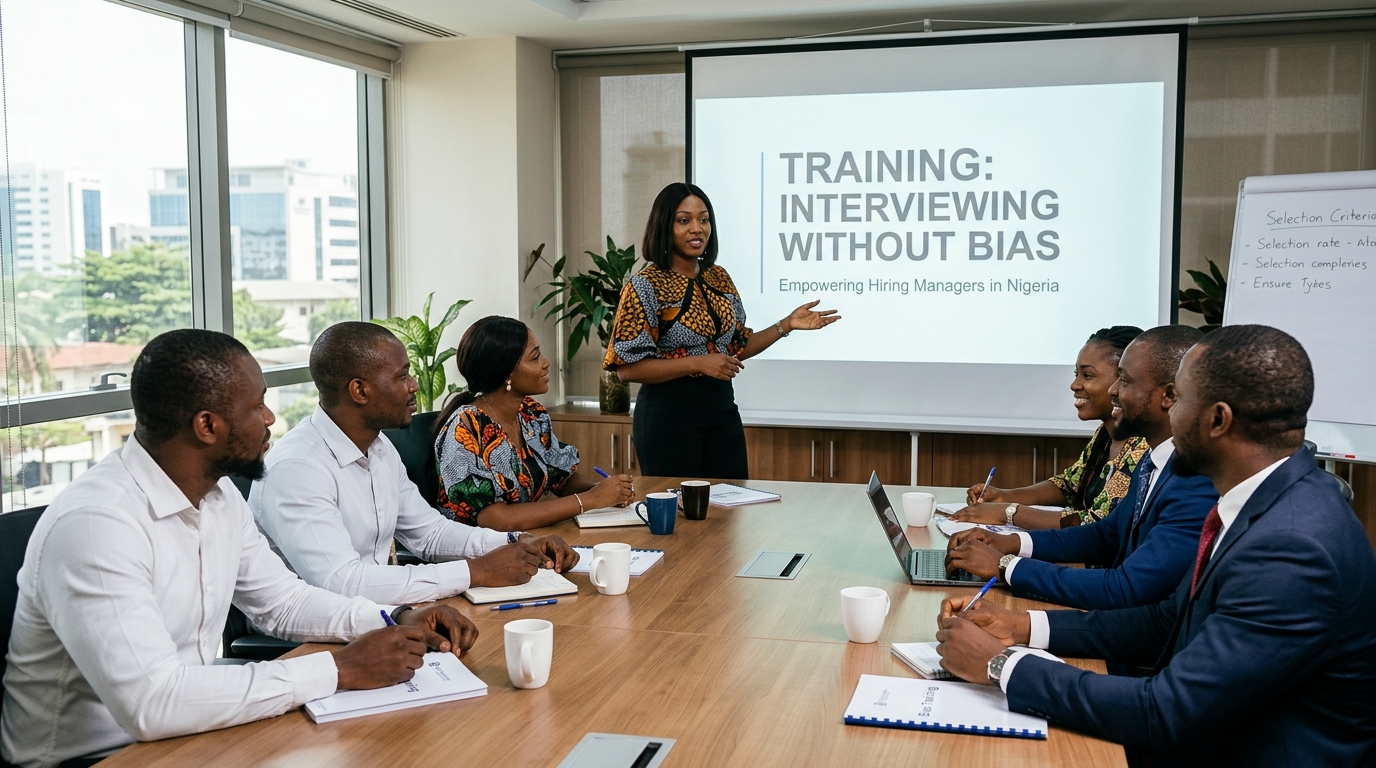
A practical guide for building a fairer, more consistent interview process
Ask most hiring managers whether they're fair interviewers, and nearly all of them will say yes. Ask them to explain exactly how they arrived at their last hiring decision, and the answer usually gets vaguer — something about "gut feel," about a candidate who just "seemed like the right fit," about an instinct they trusted. That gap between how fair we believe we are and how our brains actually process a 45-minute conversation with a stranger is where bias lives. It doesn't announce itself. It shows up as a warm feeling of rapport with one candidate and a nagging, hard-to-name discomfort with another, and it convinces the interviewer that both reactions are simply good judgment.
This matters more than most hiring teams treat it. Research from LinkedIn's Talent Acquisition Trends work found that only around 38 percent of hiring managers receive any formal interview training before they start conducting interviews, meaning the large majority are running one of the highest-stakes conversations in the business purely on instinct and informal observation. Left untrained, that instinct doesn't average out to fairness. It tends to systematically favor candidates who remind the interviewer of themselves, and to systematically penalize candidates who don't, which is a expensive way to build a team, because it means passing over qualified people for reasons that have nothing to do with their ability to do the job.
Training hiring managers to interview without bias isn't about turning them into robots or stripping the conversation of its human element. It's about giving them a structure sturdy enough that instinct has less room to quietly run the show.
Start With Naming the Biases Themselves
Bias training that stays abstract, "be aware of unconscious bias", rarely changes behavior, because it gives people nothing concrete to catch themselves doing. It works far better to name the specific patterns hiring managers are likely to fall into, with real examples, so they can recognize the feeling in the moment it happens rather than only in hindsight.
A few of the most common patterns worth walking through explicitly:
Affinity bias — the tendency to warm up to candidates who remind us of ourselves: same university, same hobbies, same accent, same sense of humor. It feels like rapport. It's actually a poor predictor of job performance, and left unchecked, it quietly narrows a team toward sameness over time.
The halo effect and its opposite, the horn effect — letting one strong trait (a prestigious employer on the CV, a confident opening answer, a polished tone) cast a positive glow over everything else about a candidate, or letting one weak trait (a quiet introduction, an unfamiliar accent, a resume gap) cast a shadow over an otherwise strong profile. Both distort the evaluation of everything that comes after that first impression.
Confirmation bias — forming an early opinion, often within the first few minutes, and then unconsciously asking questions that confirm it rather than test it. A hiring manager who's already decided they like a candidate tends to lob them softer questions; one who's already decided they don't tends to interrogate rather than explore.
Attribution bias — explaining a candidate's actions through their character rather than their circumstances. A candidate who left a previous role quickly gets read as "not committed" rather than considering that the role, manager, or company situation may have been the actual problem.
Teaching hiring managers to recognize these patterns by name, with the specific feeling attached to each one, is what turns "unconscious bias" from a vague HR phrase into something a manager can actually catch themselves doing mid-interview.
Replace Instinct With Structure
Naming the biases is step one. The step that actually changes outcomes is structural: giving hiring managers a process rigid enough that even a biased instinct has fewer places to hide.
Ask every candidate for a given role the same core questions, in roughly the same order. This is the single highest-leverage change a hiring program can make. When every interviewer asks whatever comes to mind, candidates simply cannot be compared fairly, one gets probed on a weakness, another never faces the equivalent question, and the resulting "gut feel" difference between them is really just a difference in what they happened to be asked.
Build the questions and evaluation criteria before you meet a single candidate, tied directly to what the role actually requires. Deciding what "good" looks like in advance, and writing it down, makes it much harder to unconsciously move the goalposts for a candidate you already like.
Use a scorecard, not a summary. Rating specific, predefined competencies (not an overall "how did you feel about them?") forces the evaluation to rest on evidence tied to the role rather than on a diffuse overall impression that's disproportionately shaped by whichever bias happened to be active that day.
Train on the STAR method (Situation, Task, Action, Result) for asking and evaluating behavioral questions, so answers are assessed on what a candidate actually did in a real situation rather than on how smoothly or confidently they told the story.
Score independently before discussing as a group. When interviewers compare notes before writing down their own scores, the most senior or most vocal person in the room quietly anchors everyone else's opinion. Independent scoring first, followed by a group discussion to reconcile differences, protects against that.
Use diverse interview panels wherever possible, and rotate who's on them. A single interviewer's affinity bias is much less likely to steer an outcome when the final decision draws on several different people's independent evaluations rather than one person's impression.
Practice, Don't Just Present
A one-hour slideshow on unconscious bias, delivered once during onboarding and never revisited, has close to no lasting effect on behavior. What actually builds the skill is practice with feedback:
- Run mock interviews with role-play, ideally including a scenario deliberately designed to trigger a common bias, so hiring managers can notice the pull toward it in a low-stakes setting before it happens with a real candidate.
- Use calibration sessions, where a group of interviewers independently score the same recorded or simulated interview and then compare results. Large gaps in scoring reveal exactly where inconsistency (and likely bias) is creeping in, and give the group a concrete, shared example to discuss rather than an abstract principle.
- Give hiring managers a self-awareness tool, such as an implicit association exercise, not as a verdict on their character but as a way of surfacing blind spots they can then consciously watch for.
- Debrief real interviews periodically. Occasionally have someone review a hiring manager's actual interview notes or scorecards against the agreed rubric, and give direct feedback on where the evaluation strayed from the evidence.
Treat this as an ongoing practice, not a one-time certification. Skills built through repetition and feedback stick; skills presented once in an onboarding deck rarely survive contact with a busy hiring season.
Teach the Legal Boundaries Explicitly, Not by Assumption
Many hiring managers genuinely don't know which questions are inappropriate or risky until someone tells them directly, they ask about a candidate's marital status, family plans, age, or health as harmless small talk, without realizing the question itself can become evidence of discriminatory intent if that candidate is later rejected. Training should spell out, in plain terms and with real examples, what not to ask and why, not as a legal disclaimer nobody reads, but as a working part of interview skills training.
In Nigeria specifically, this deserves direct attention rather than being treated as a generic global boilerplate. Section 42 of the 1999 Constitution guarantees freedom from discrimination on the grounds of place of origin, sex, disability, religion, ethnic association, and similar factors, and the Discrimination Against Persons with Disabilities (Prohibition) Act 2018 specifically prohibits disability-based discrimination in employment. But the more persistent, harder-to-legislate-away pattern that Nigerian hiring managers should be trained to recognize in themselves is what's widely known locally as tribalism, evaluating candidates more favorably based on shared ethnicity, state of origin, or personal connection rather than merit. Research on the topic has documented that job opportunities in both the public and private sector are frequently shaped by tribal or regional ties rather than qualifications, and separate research on employment discrimination has found that job seekers with visible tribal marks face measurable social stigma and rejection in hiring, sometimes with serious psychological consequences. Naming this pattern directly, rather than only discussing bias in the abstract terms used in Western HR literature, makes bias training genuinely relevant to how discrimination actually shows up in Nigerian hiring, and a structured, scorecard-based interview process is one of the most effective practical defenses against it, precisely because it forces the evaluation back onto job-relevant evidence rather than personal or tribal affinity.
Make Fairness Something the Organization Tracks, Not Just Trains
Training changes behavior more reliably when there's a feedback loop showing whether it's actually working. A few practices worth building in:
- Track hiring outcomes over time — who advances at each stage, who receives offers, broken down in ways that can reveal patterns worth investigating, without turning the exercise into a quota system.
- Set clear, specific goals for what a fairer process should achieve, and revisit them regularly rather than treating a single training session as "done."
- Collect candidate feedback on how the interview process felt to them, which often surfaces problems, an interviewer who dominated the conversation, a question that felt inappropriate — that internal metrics alone won't catch.
- Review adverse outcomes specifically. If a particular group of candidates consistently drops off at the interview stage rather than the application stage, that's a signal worth investigating rather than dismissing as coincidence.
The Underlying Point
No training program eliminates bias completely, it's a feature of human cognition, not a bug that can be patched out with a single workshop. What good training actually does is shrink the space where bias operates unchecked, by replacing "whatever felt right in the room" with a structure that has to be justified against evidence, applied consistently, and checked over time. Hiring managers who go through this kind of training don't just make fairer decisions. They also, almost as a side effect, tend to make more accurate ones, because a process built to resist bias is, not coincidentally, a process built to actually measure whether someone can do the job.
This article draws on current research and practitioner guidance on structured interviewing, unconscious bias training, and interview calibration, alongside Nigeria-specific legal and workplace-discrimination research current as of mid-2026. It is intended as general guidance, not legal advice, employers should confirm specific compliance obligations with a qualified professional.