 By MyJobAlly
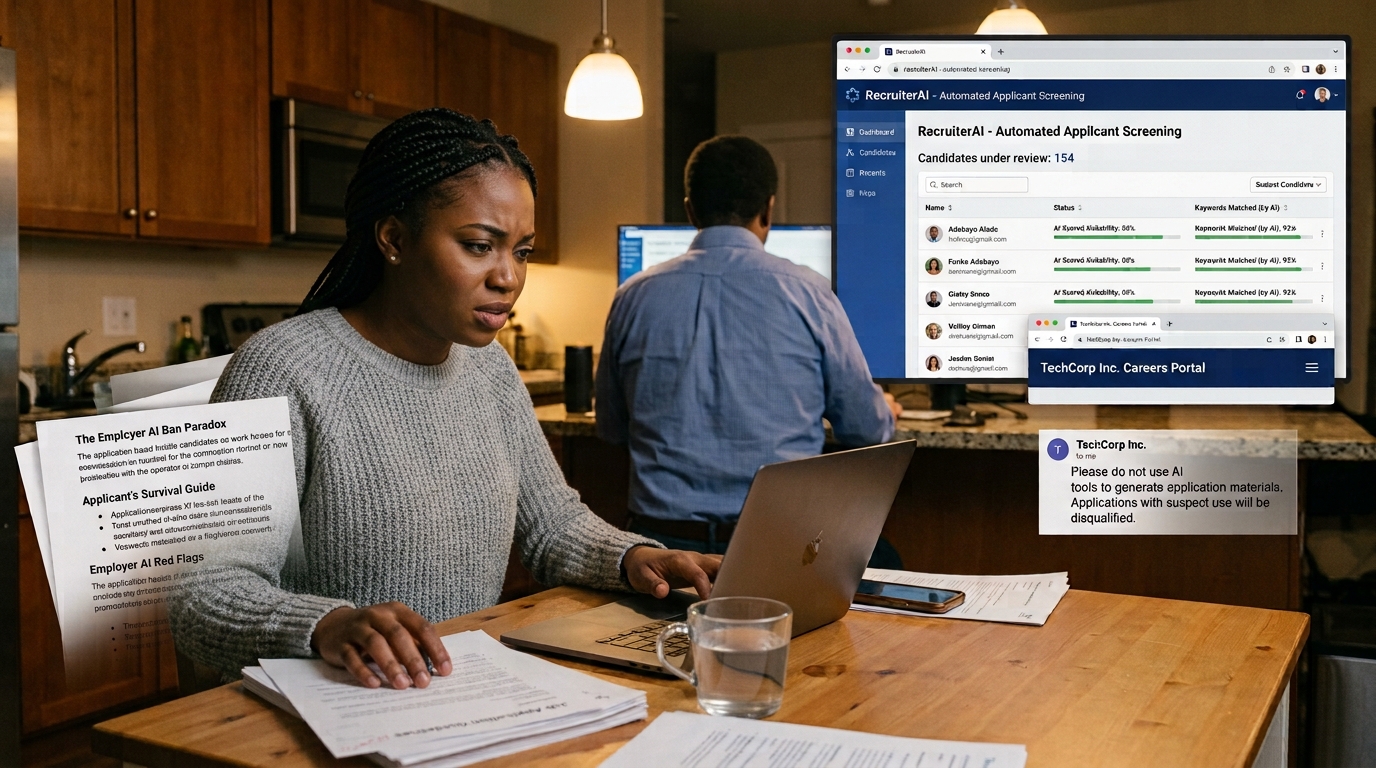
Many employers screen your CV with AI, then ask whether you used AI to write it. Here is what the data says about the double standard, the fair case on each side, what Nigerian law says about automated hiring, and how to protect yourself.
Last updated: 18 October 2026
The Short Answer
Yes, the double standard is real, but it is not total. Most employers use AI somewhere in hiring, and many are wary of candidates who use it, with some restricting AI in interviews or assessments. The practical rule that holds across most policies is simple: use AI to prepare and polish, write the substance yourself, never use it where it is banned, and be ready to explain every claim on your CV. In Nigeria, you also have a legal right not to be subject to a significant decision based solely on automated processing.
Key Takeaways
- Employers use AI heavily. A Resume Genius survey of 1,500 US organisations found 87 percent use AI in hiring and 58 percent use it to screen resumes, while 82 percent of hiring managers worry about applicants' use of AI (Forbes).
- Transparency is uneven. The same survey found one in five companies don't disclose their own AI use to candidates.
- Detection is growing. Greenhouse found 61 percent of US hiring managers run software to spot candidate AI use, according to summaries of its 2026 research (Gethyn Ellis).
- Policies differ by employer. Some ban AI in interviews, some require it, and Anthropic, the maker of the Claude assistant, tells candidates to write first drafts themselves and use AI only to refine them (Anthropic).
- Nigerian law gives candidates a safeguard. Section 37 of the Nigeria Data Protection Act 2023 gives individuals the right not to be subject to a decision based solely on automated processing that has significant effects (Law Global Hub).
How Widespread Is the Double Standard?
On the employer side, AI is everywhere in the funnel. A TestGorilla survey, reported by The Interview Guys, found 61 percent of employers use generative AI to screen resumes and 52 percent to source candidates (The Interview Guys). CV-Library's March 2026 research found 83 percent of UK recruiters use AI somewhere in hiring, with 28 percent relying on it to screen applications (Gethyn Ellis). A law firm's April 2026 review estimates that 99 percent of Fortune 500 companies use AI to filter applicants, and about 40 percent of companies expect to use AI for screening interviews (Bricker Graydon). A LinkedIn survey of more than 6,500 HR professionals found two-thirds of recruiters planned to increase AI pre-screening interviews, and a Greenhouse survey found nearly two-thirds of job seekers had already been interviewed by AI (CNBC).
On the candidate side, attitudes are harder. The Interview Guys report that 54 percent of hiring managers say they would penalise a candidate for using AI on an application, while 96 percent of managers use AI in their own hiring tasks (The Interview Guys). That comes from a career-coaching site summarising several surveys, so treat the pairing as indicative. UK research reported in May 2026 found only 16 percent of UK HR decision-makers view candidate AI use positively and 28 percent negatively, even though 83 percent of UK recruiters use AI themselves (Gethyn Ellis).
Most of this data is from the United States and United Kingdom and some comes from vendors, so it is a benchmark, not a measure of Nigerian employers.
What Employers Actually Say About AI in Applications
The picture isn't just "ban". It is a spectrum.
- Allowed with limits. Anthropic's published guidance asks applicants to create their first draft themselves, then use Claude to refine it, encourages using AI to research the company and practise answers, and says live interviews allow no AI assistance unless the interviewer indicates otherwise. It also says it uses Claude to create job descriptions, develop interview questions, transcribe interviews, and identify candidates to source, and that it doesn't let Claude make hiring decisions (Anthropic). Fortune reported that the company had barred AI use in applications in May 2025 and then revised its guidance by July (Fortune). That shift suggests policies are still settling.
- Banned in interviews. Reports say Amazon asks candidates to acknowledge a no-AI rule and may disqualify those caught using AI, and that Goldman Sachs has banned AI in its recorded video interviews (Assistly). These are secondary summaries, so check each company's current candidate instructions.
- Required or encouraged. Canva expects some engineering candidates to use AI tools in technical interviews, Shopify allows any AI in coding rounds, and McKinsey piloted letting some graduates use its internal AI in case interviews, according to a tracker of employer stances (Uncharted Career).
The same tracker's advice is worth remembering: assume AI is off in an interview unless the invitation says otherwise, because silence isn't permission.
The Case for the Employer
It would be unfair to call every restriction hypocrisy. Employers have three reasonable concerns.
- Authenticity. They want to see what you can do, not what a tool can do. A Resume Genius figure in the Forbes piece shows 82 percent of hiring managers worry AI obscures genuine abilities.
- Exaggeration. A Kahoot survey reported that 51 percent of graduates admit exaggerating their skills when using AI (Gethyn Ellis). Any employer reading that would worry.
- Volume. AI makes it cheap to send many polished applications, which pushes employers to use AI screening just to cope.
There is also a real difference between using AI to process information (sorting, scheduling) and using AI to represent yourself. The stakes and the accountability differ.
The Case for the Candidate
The candidate's complaint is also reasonable.
- Opacity. Candidates are asked to disclose AI use, while one in five companies don't disclose theirs, per the Resume Genius survey above.
- Bias risk. A May 2026 working paper cited by CNBC found large-scale evidence of racial disparities when many employers use the same hiring algorithms, and that applicants rejected by one employer could be rejected everywhere (CNBC). Complaints against HireVue and Workday allege bias based on age, race, and disability, and an applicant lawsuit against hiring platform Eightfold filed in January 2026 focuses on lack of transparency (Bricker Graydon). These are allegations in legal and research proceedings, not findings against any named company.
- A filtering problem for honest candidates. A Daily Trust report on Nigerian job seekers quotes experts saying many qualified candidates struggle to get noticed because their CVs can't pass the software employers use, and several describe using tools like ChatGPT to improve their CVs while editing the output to sound human (Daily Trust). The advice from officials in that report was to be authentic.
- Fatigue. CNBC reports some candidates are dropping out of processes that involve AI interviews and blacklisting companies.
What Does Nigerian Law Say?
Nigeria has no statute dedicated to AI in hiring, but the Nigeria Data Protection Act 2023 applies. Section 37 gives a data subject the right not to be subject to a decision based solely on automated processing, including profiling, that produces legal or similar significant effects. There are exceptions where the decision is necessary for a contract, authorised by written law with safeguards, or based on consent, and even then the controller must provide suitable safeguards, including the right to obtain human intervention, express a point of view, and contest the decision (Law Global Hub, quoting section 37). Templars, a Nigerian law firm, explains that employers cannot rely solely on AI to make hiring decisions and that exceptions require human oversight, transparency, and candidates' rights to review and challenge outcomes (Templars). Some employers already reflect this in candidate notices. One Nigerian bank candidate privacy notice lists the right to request not to be subject to automated decision making and points to the Nigeria Data Protection Commission for complaints (Citigroup Nigeria candidate privacy notice).
Three cautions. Whether a specific screening process is "solely automated" depends on the facts, such as whether a human reviews the result. The law doesn't ban AI screening, it limits purely automated significant decisions. And this is general information, not legal advice.
How to Protect Yourself: A Practical Playbook
- Read the rules before you apply. Look for AI statements in the job post, application portal, and interview invitation. If there is no guidance, assume AI is off during live interviews and assessments.
- Follow the common-sense model. Draft your answers yourself, then use AI to tighten wording and fix grammar. Use AI to research the employer and practise interviews. Keep it off live interviews and timed tests unless told otherwise. That mirrors Anthropic's published approach and many employers' unwritten expectations.
- Never submit what you can't defend. Every claim, number, and tool on your CV must be true and explainable in an interview. Exaggeration is the behaviour detection tools and sceptical managers are hunting for.
- Keep your voice. Add specific details only you know: the project, the customer, the result. Generic text is the easiest to spot and the easiest to forget.
- Write for people and for software. Use clear headings and honest keywords from the advert, as Huntr's data suggests moderate matching works better than stuffing (Huntr). Our guide to CV mistakes that cause instant rejection covers the basics, and a complete profile helps too (why an incomplete job board profile costs you offers).
- Answer honestly if asked. If a form asks whether you used AI, say so truthfully and briefly describe how, such as "I used it to check grammar after writing my own draft."
- Know your rights. If you suspect an automated rejection, ask whether a human reviewed your application and request a review. Keep copies of your application and any messages. If you need to escalate, the Nigeria Data Protection Commission handles complaints.
- Build proof AI can't fake. A portfolio, a live demonstration, references, and clear examples of past work make you hard to confuse with a generic applicant.
- Watch for red flags. No human contact at any stage, no mention of how your data is used, or pressure to pay a fee are all warning signs. Never pay to be hired.
- Keep building AI skills. Employers increasingly value people who can work with AI well. See AI skills employers now expect from every candidate and check how exposed your field is in jobs most and least exposed to AI automation.
What Employers Could Do to End the Double Standard
If you hire, a few steps would restore trust. Publish a clear candidate AI policy that says what is allowed at each stage. Disclose how you use AI in screening and interviews. Keep a human responsible for final decisions. Check vendors for bias and keep records. Offer a way to ask for human review. And test skills with live work samples instead of relying on detection software. Surveys suggest that if employers expect candidates to be honest about AI, being transparent about their own use is the fair counterpart (Forbes).
Is It Really Hypocrisy? A Balanced Verdict
Partly. Using AI to sort thousands of applications and objecting to AI-written ones are not identical acts, so some of the gap is justified. But the double standard becomes real when employers hide their own use, ban a tool they rely on without explaining why, or reject candidates through opaque automated systems with no human review. The fairest position is reciprocal transparency: employers state how they use AI, candidates state how they use it, and both stay accountable for the result.
What Not to Do
Don't use a live AI assistant in an interview or test that bans it. It can end your application, and Nigerian employers may adopt similar rules. Don't mass-submit auto-generated applications. They look generic, and some data suggests repeated applications to the same company perform worse. Don't lie about your AI use. An honest, brief answer is safer than a denial. Don't paste sensitive personal data into tools you don't trust. Don't assume a rejection is personal. Automated filters reject many qualified people. Don't swear off AI. The goal is to use it well, not to avoid it.
Frequently Asked Questions
Do employers really ban AI in job applications? Some do, especially for interviews and assessments, while others allow or even require it. Policies vary by employer and stage, so read the instructions each time.
Do employers use AI to screen CVs? Yes, very commonly. Surveys report that more than half of employers use AI to screen resumes, though the exact share varies by sample and country.
Can employers tell if I used AI on my CV? Some use detection software, and many recruiters say they can spot generic text. Detection isn't perfect, so the safest approach is to write the substance yourself and make every claim true.
Is it okay to use ChatGPT or Claude to write my CV? Using AI to improve wording and structure is widely accepted. Replacing your own experience with generated content is risky. Write the draft yourself, then refine it.
Can I be rejected by AI alone in Nigeria? Employers use AI screening, but the Nigeria Data Protection Act limits decisions based solely on automated processing that have significant effects, subject to exceptions and safeguards. You can ask for human review.
What should I do if an application asks whether I used AI? Answer truthfully and briefly, and explain the limited way you used it.
Should I use AI in a job interview? Only if the employer says it is allowed. Using AI during a live interview that bans it can get you disqualified.
The Bottom Line
The double standard exists: employers are using AI to read your CV while many ask whether you used AI to write it. But the sensible response is not anger or avoidance. It is to understand the rules, use AI to prepare and polish, keep the substance honest and your own, ask questions about how you're being assessed, and know your rights. And if you hire, make your own AI use as transparent as the standard you ask of candidates.
This article draws on Forbes (reporting Resume Genius), CNBC, Bricker Graydon, Fortune, Anthropic's published candidate guidance, The Interview Guys, Gethyn Ellis, Assistly, Uncharted Career, Templars, Law Global Hub, Daily Trust, Citigroup's Nigeria candidate privacy notice, and Huntr, current as of October 2026. Most survey data comes from the United States and United Kingdom, much of it from vendors and secondary summaries, and is used as a benchmark only. Employer AI policies change frequently, so check each employer's current instructions. Allegations in lawsuits and working papers are not findings against any named company. The legal summary is general information, not legal advice. This article is not career advice.