 By MyJobAlly
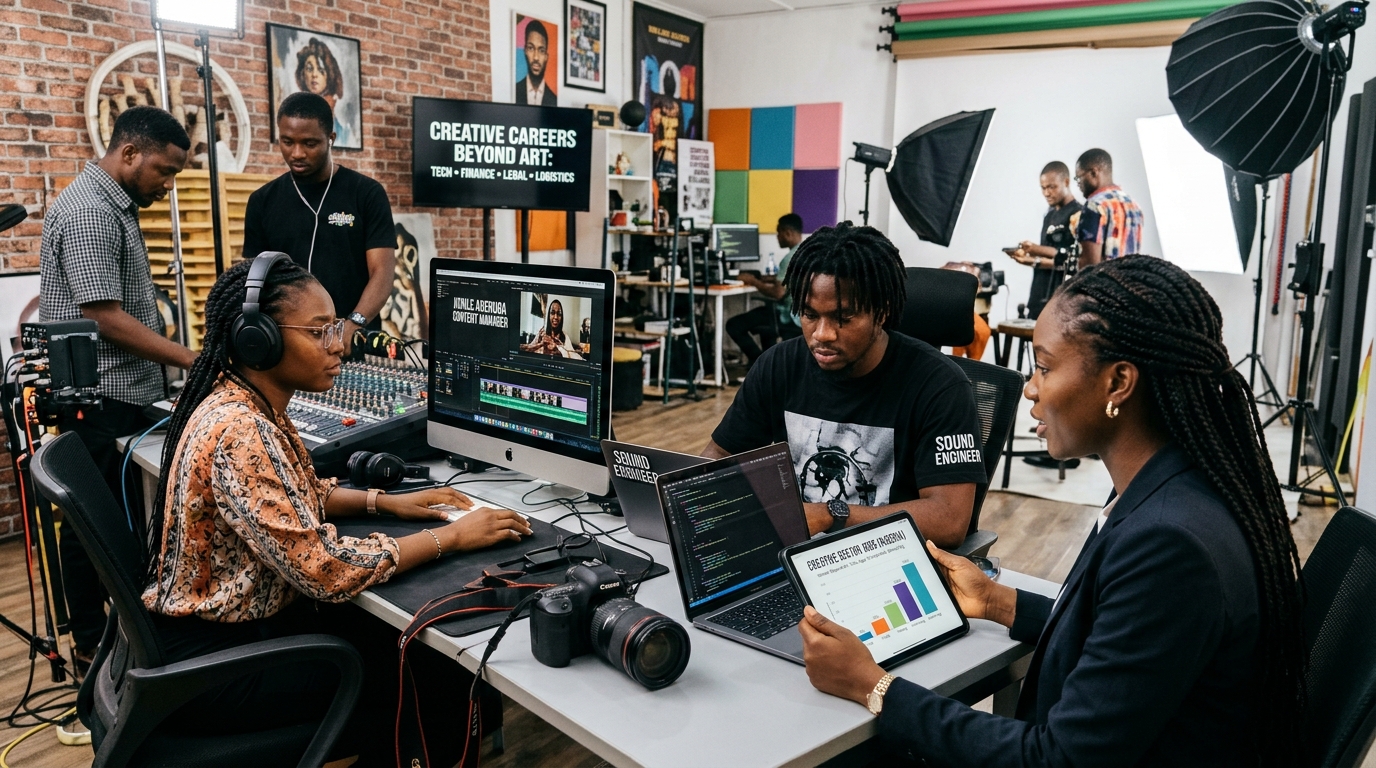
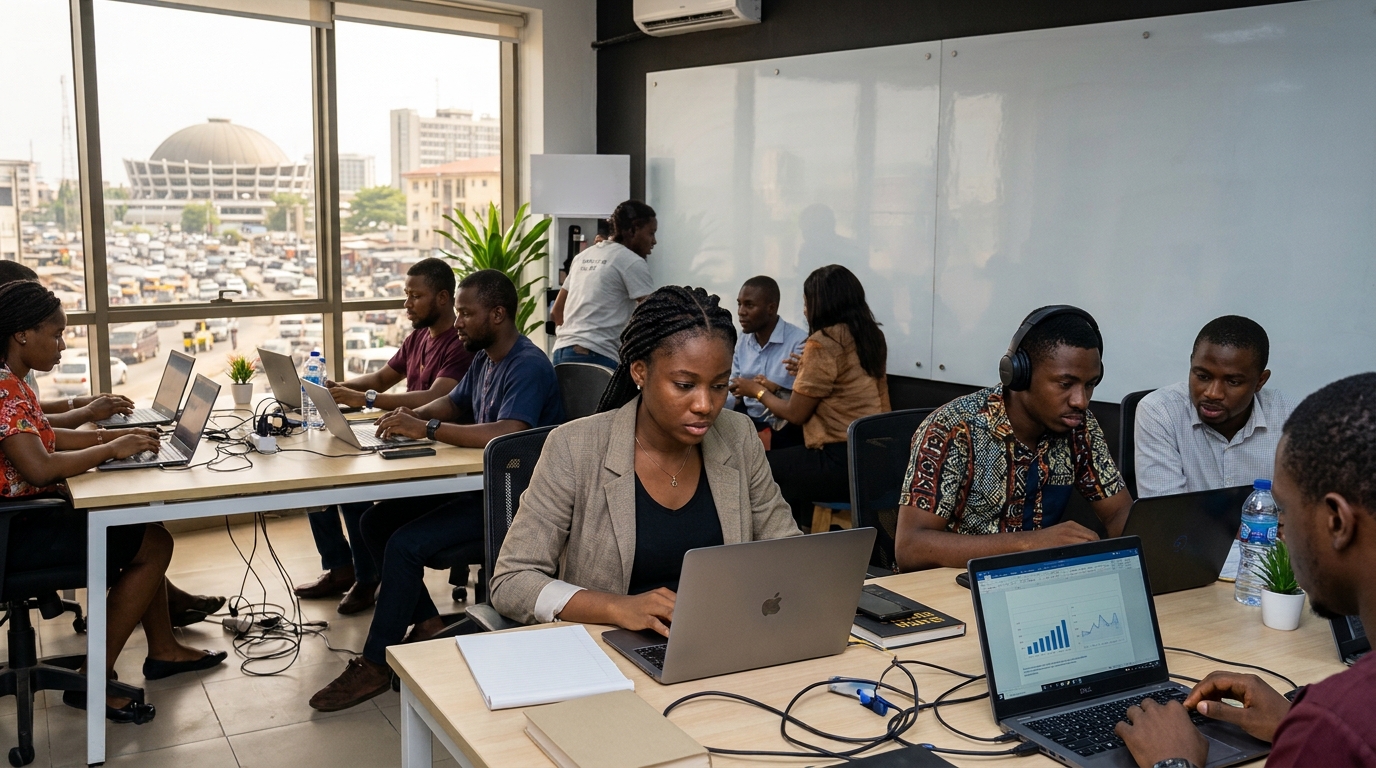
Film, music, games, content and design are turning into real job markets, and the best openings sit behind the camera, the mic and the screen
Last updated: November 14, 2026
Quick answer: Nigeria's creative economy employs about 4.2 million people and the Federal Government wants it to add 2 million more jobs by 2030. The fastest-growing roles are not only acting and singing. They include microdrama writers, video editors, VFX and sound specialists, game developers, producers, artist managers, social media managers, faceless AI content producers for YouTube, TikTok and Facebook, and creative business operators. Most of these careers reward visible, documented work more than certificates.
Key takeaways
- About 4.2 million Nigerians already work in the creative economy, which contributes roughly 1.2% to 2% of GDP, according to figures reported by Nairametrics.
- The government target is 2 million additional jobs and about 2.3% of GDP by 2030.
- Cinemas, Afrobeats, games and online creators are all producing new job titles, and many of them support the stars rather than being the stars.
- Faceless AI content for YouTube, TikTok and Facebook is a low-cost way in, but YouTube's monetisation bar doubles for new channels from February 1, 2027, and mass-produced AI content is a policy risk.
- The biggest obstacles are systems, not talent: payments, power, financing and admin.
- You do not need to be famous to build a creative career. You need a skill employers and clients can see.
Ask a Nigerian parent what a "creative career" means and you may hear one of three words: musician, actor, or "that thing that doesn't pay." Ask a producer, a game studio founder or a talent manager in Lagos and you will hear something different. They are hiring editors, sound engineers, animators, writers, brand managers and project coordinators, and they struggle to find enough of them.
This article looks at where the creative industry is actually growing in Nigeria, which careers are opening up, what stands in the way, and how to position yourself if you want in.
The size of the opportunity
The Federal Government says the creative sector currently contributes roughly 1.2% to 2% of GDP and employs about 4.2 million Nigerians. It expects the sector to reach about 2.3% of GDP and add 2 million jobs by 2030, according to Nairametrics' report from August 2026. The director-general of the National Institute for Policy and Strategic Studies, Professor Ayo Omotayo, has gone further and argued the sector could contribute up to $450 billion, though that is a statement of potential, not a forecast.
A UK-Nigeria creative fund announced in May 2026 adds an important detail. Over 80% of creative practitioners in Nigeria are self-taught, and fewer than 10% have access to formal financing. In plain terms, this is a sector that grew by talent and hustle, with very little structure around it. That is exactly why it needs more people with organised, professional skills.
Film: cinemas are filling and crews are needed
Nollywood is often discussed as stories and stars, but a cinema release employs hundreds of people behind the scenes. In the first half of 2026, Nigerian cinemas took in nearly ₦8.8 billion, a total already above the full-year box office for each year from 2019 to 2023, BusinessDay reported in July. The top Nollywood title, Call of My Life, earned ₦686.8 million. The same report puts 2025 total revenue at ₦15.6 billion, with Nollywood and Hollywood holding equal shares.
More box office means more productions, and more productions need people who rarely appear on posters: line producers, directors of photography, editors, colourists, sound designers, script supervisors, location managers and production accountants.
The newest format is the microdrama, short vertical episodes made for phones. The Digital Creator Africa Academy for Microdrama plans to train 300 people in a free three-week programme covering scriptwriting, directing, production, editing, AI filmmaking and acting, with the global vertical video economy valued above $26 billion. Organisers say AI tools could cut production time and costs by up to 70% for independent teams. Whether or not that figure holds, it shows where the industry is heading: smaller, faster teams, and people who can write, shoot and edit quickly.
Music: the producer, the engineer and the manager
Afrobeats is estimated to contribute about $2 billion a year to the global music economy, while Nigeria's own music industry is valued at ₦901 billion, or over $600 million, according to Nairametrics' July 2026 profile of the producers behind Afrobeats' biggest YouTube hits. That profile makes a point worth noticing: the hit songs are credited to a roster of producers, sound engineers and mixing specialists, many of them Lagos-based, such as Magicsticks, who is reported to have produced, mixed and mastered every track on Asake's debut album.
Careers in this space include music producer, recording and mixing engineer, mastering engineer, A&R, artist manager, tour manager, publishing and rights administrator, and music marketer. A ThisDay review of the creative industry also points to AI-assisted mixing and mastering as a growing part of the work, which means technical skill matters more, not less.
Games and animation: small teams, global markets
At Lagos Games Week in June 2026, the message from organisers was that talent alone will not build a games industry. Nigeria needs sustainable studios that create IP, generate skilled jobs and export African stories. Studios named at the event include Maliyo Games and Gazuntype, whose game Go North is set for release on Xbox.
Careers here include game designer, 2D and 3D artist, animator, gameplay programmer, QA tester, community manager, producer and publishing lead. ThisDay's analysis also sees animation as a strong export format, along with VFX, post-production and virtual production roles, because those skills can be delivered for local and international clients. If you already work in tech, our guide on cybersecurity jobs in Nigeria shows how a technical background can open adjacent doors, and games studios need security and infrastructure people too.
Content creation: the "entire operation behind the face"
Online creators are the most visible part of the new creative economy, but the jobs are in the team around them. Techeconomy, writing in September 2026, noted that creators increasingly run small businesses with editors, photographers, graphic designers, social media managers, talent managers, stylists, videographers and brand partnership staff behind them.
The creator market itself is large. A Guardian report summarised in March 2026 valued Nigeria's creator market at $3.1 billion, with a target of $17.8 billion by 2030, but it also noted that more than half of creators across Africa earn under $100 a month. Many creators rely on brand deals and personal networks, which means the ones who succeed are often those who can run their work like a business. At the African Creators Summit, which brought together more than 2,500 creators from 15 countries, speakers argued that content creation should be recognised as full-time work.
The honest takeaway: being the face is a high-risk bet, and working behind the face is a steadier career.
Faceless AI content: a real door in, with real rules
One of the fastest-growing entry points for young Nigerians is faceless content: channels and pages on YouTube, TikTok and Facebook that never show the creator's face. Instead they use voiceovers, stock or AI-generated footage, animation, screen recordings, slideshows and text-on-screen. Typical formats include explainers, history and finance stories, motivational clips, news recaps, product reviews, kids' stories and Nollywood or Afrobeats commentary. AI tools now handle scripting help, voice generation, image and video creation, subtitles and editing, so a person with a phone, data and a good eye can produce a polished video without a studio or an on-camera personality.
The skills behind it are genuine jobs: scriptwriting, research and fact-checking, voiceover direction, video editing, thumbnail and graphic design, prompt writing, channel strategy and analytics. Creators and businesses increasingly pay for these as services, which makes faceless production a way to start freelancing even if you never launch your own channel. Our guide on why every employee should learn prompt engineering covers the AI side of the skill set.
Before you quit anything for it, know the rules and the money:
- YouTube is tightening. From February 1, 2027, new applicants to the YouTube Partner Programme will need 1,000 subscribers plus either 8,000 public watch hours in the previous 12 months, up from 4,000, or 20 million Shorts views in 90 days, up from 10 million, according to Brandcom and Techpoint Africa. Existing members are exempt from the new entry thresholds.
- Mass-produced AI content is a monetisation risk. YouTube's "inauthentic content" policy targets content that is largely automated, copied or produced at scale without meaningful creative input, while saying creators who use AI can still monetise if the final video is original and valuable. Techpoint reports that YouTube widened the definition again in July 2026 to cover low-quality repetitive material, including mass AI-generated content. Faceless does not mean effortless. Your voice, research, angle and editing are what keep a channel eligible.
- Nigerian payouts are lower and leaky. Techpoint reports that advertisers pay less to reach African audiences, and that YouTube withholds 30% of a Nigerian creator's earnings from US views because there is no tax treaty with the US. Condia notes that six in ten African creators earn under $100 a month and that brand deals, not platform ads, are the main income source for many.
- Platforms change. Facebook has monetisation for Nigerian creators, and Meta's Creator Fast Track pays established creators with at least 100,000 followers elsewhere, but Nairametrics notes the offer does not say whether Nigerian creators are eligible. Condia also warns against depending on one feature of one app after TikTok's temporary block on late-night livestreaming in Nigeria.
The smart move is to treat faceless content as a skill and a business, not a get-rich shortcut. Build a small portfolio, offer editing or scripting to creators and brands, and use your own channel as proof of work. Brands increasingly favour niche creators with engaged audiences. Condia gives the example of a 20,000-follower fintech explainer winning more work than an entertainment page with ten times the reach, which is good news for anyone building authority in a specific topic.
What is holding the sector back
Nigeria's creative professionals are not short of ideas. They are short of working systems. The State of Nigeria's Creative Economy 2026 report, based on 377 creative professionals, found that 57% of export-related barriers come from payment processing and foreign exchange issues, and 83% of respondents lose more than 10% of their working week to admin such as logistics, contracts and chasing payments. Power and internet connectivity ranked as the biggest daily challenge. The report's conclusion was that the problem is "systems, not talent".
ThisDay's review adds further risks: IP protection, tax pressure on small production companies, and a shortage of venues. The Guardian report cited above also notes that Nigeria taxes freelancers earning above ₦50 million but offers no creator-specific tax relief or public funding stream.
Policy is trying to respond. The Federal Executive Council approved a Creative Economy Development Fund in October 2024 to give creatives debt, quasi-equity and equity finance, with a pilot to let creators use their intellectual property as collateral. The 2024 announcement did not state the fund's size, so treat it as a direction of travel and not a guaranteed source of money.
The jobs hiding in plain sight
If you read the sources above together, a pattern appears. The sector needs more than performers. It needs people who can make the machine work:
- Production and operations: producers, project managers, production coordinators, line producers
- Technical craft: editors, colourists, VFX artists, sound designers, mixing engineers
- Digital growth: social media managers, community managers, performance marketers, analytics specialists
- Business and rights: talent managers, contract and rights administrators, finance and payments specialists
- Emerging formats: microdrama writers, AI-assisted production artists, game artists and designers
- Faceless content production: scriptwriters, researchers, voiceover artists, video editors, thumbnail designers and channel managers for YouTube, TikTok and Facebook
The last two groups matter most for job seekers, because they overlap with skills you may already have. A project manager from banking, an accountant, a marketer or a lawyer can all find a place in a creative business that is struggling with admin, payments and contracts.
How to start a creative career in Nigeria
- Pick a lane inside the industry. "I want to work in entertainment" is too wide. "I want to edit short-form video for brands" is a job.
- Build proof before you ask for work. A portfolio, a reel, a project breakdown or a short case study carries more weight than a title. Our guide on writing a CV with no experience shows how to present projects, volunteer work and personal work professionally.
- Learn the tools, and learn to check AI's work. AI is already part of editing, mixing and production. Our piece on why every employee should learn prompt engineering covers how to use it without losing quality.
- Treat your creative skill as a business skill. Learn contracts, invoicing, pricing and payment safety. Given the payment problems in the NECLive report, this is a real career advantage.
- Do not leave your income to chance. Many creatives run a creative practice beside paid work or contracts. Our guide to why job security doesn't exist anymore explains how to build a safety net.
- Learn to sell. Whether you are pitching a brand, a client or a studio, selling skills keeps you employable, as we explain in why sales skill keeps you employable.
- Follow up professionally. Creative hiring often runs on relationships. If you are applying and hearing nothing, read why recruiters ghost you.
Looking for your next role in the creative, media or digital space? Create your free MyJobAlly profile, add your portfolio and skills, and let employers across Nigeria find you.
For employers and studios
If you run a production house, label, game studio, agency or creator business, the same shortages affect you. The people you need are often not artists but editors, producers, finance staff and operations managers. Posting those roles clearly, with real responsibilities and honest pay ranges, helps you reach candidates who might not think of themselves as "creative". If you need editors, scriptwriters, voiceover artists or faceless-content producers, sign up as an employer on MyJobAlly and reach candidates looking for creative, media and digital roles in Nigeria.
Frequently asked questions
How many people work in Nigeria's creative economy? About 4.2 million, according to figures cited by the Federal Government and reported by Nairametrics. The government targets 2 million additional jobs by 2030.
What creative careers are growing fastest in Nigeria? Microdrama and video production, editing and post-production, VFX, music production and engineering, game development, social media and community management, and talent and artist management all feature in recent industry coverage.
Do you need to be famous or talented to work in the creative industry? No. A large share of creative jobs are behind the scenes and depend on technical or business skills, such as editing, production, contracts, finance and marketing.
Is a creative career in Nigeria financially stable? It can be, but income varies widely. More than half of African creators earn under $100 a month, according to the Guardian report summarised by Pulse, so many professionals combine creative work with other income or contracts. Skills in production, editing or operations tend to offer steadier work than relying on audience size alone.
Do I need a degree to enter the creative industry? Not necessarily. Over 80% of Nigerian creative practitioners are self-taught, according to the UK-Nigeria creative fund announcement. Employers usually look for portfolios, results and references.
What are the biggest challenges for creatives in Nigeria? Power and internet reliability, payment and foreign exchange problems, access to financing, admin workload, and IP protection, according to the NECLive 2026 report and ThisDay.
Can you make money with faceless AI content in Nigeria? Some people do, but it is not guaranteed. YouTube is doubling its entry requirements for new Partner Programme applicants from February 1, 2027, mass-produced AI content can be demonetised under YouTube's inauthentic content policy, and Nigerian ad payouts are low and subject to 30% US withholding on US views, according to Techpoint Africa. The more reliable route is to sell the skills (scripting, editing, voiceover, thumbnails) to creators and brands while building your own channel.
Do I need to show my face to be a content creator? No. Faceless formats such as voiceover explainers, animation, slideshows and screen recordings are common. What matters is originality, quality and consistency.
Where this leaves you
Nigeria's creative industry is not a lottery for people who want to be famous. It is a growing network of businesses that need producers, editors, engineers, managers, marketers and operators. The government is aiming for 2 million new jobs. The stumbling blocks are real, but they are mostly about infrastructure and systems, which means people who can bring structure, skill and reliability are in demand.
If you have a creative skill, document it. If you have a business skill, find the creative company that needs it. And if you want employers to find you, start with your free MyJobAlly profile.
Sources include Nairametrics, BusinessDay, ThisDay, Premium Times, Techeconomy, Africanews, Games Industry Africa, AllAfrica, Brandcom, Techpoint Africa, Condia, Creator Handbook and the Federal Ministry of Information and National Orientation, with a Guardian Nigeria report summarised by Pulse, current as of November 13, 2026. Platform rules and payout terms change often, so check YouTube, TikTok and Meta's current policies before investing time or money. Some figures are projections or targets and may change. The NECLive survey covers 377 professionals and may not represent every creative sector. This is general information, not professional or financial advice.